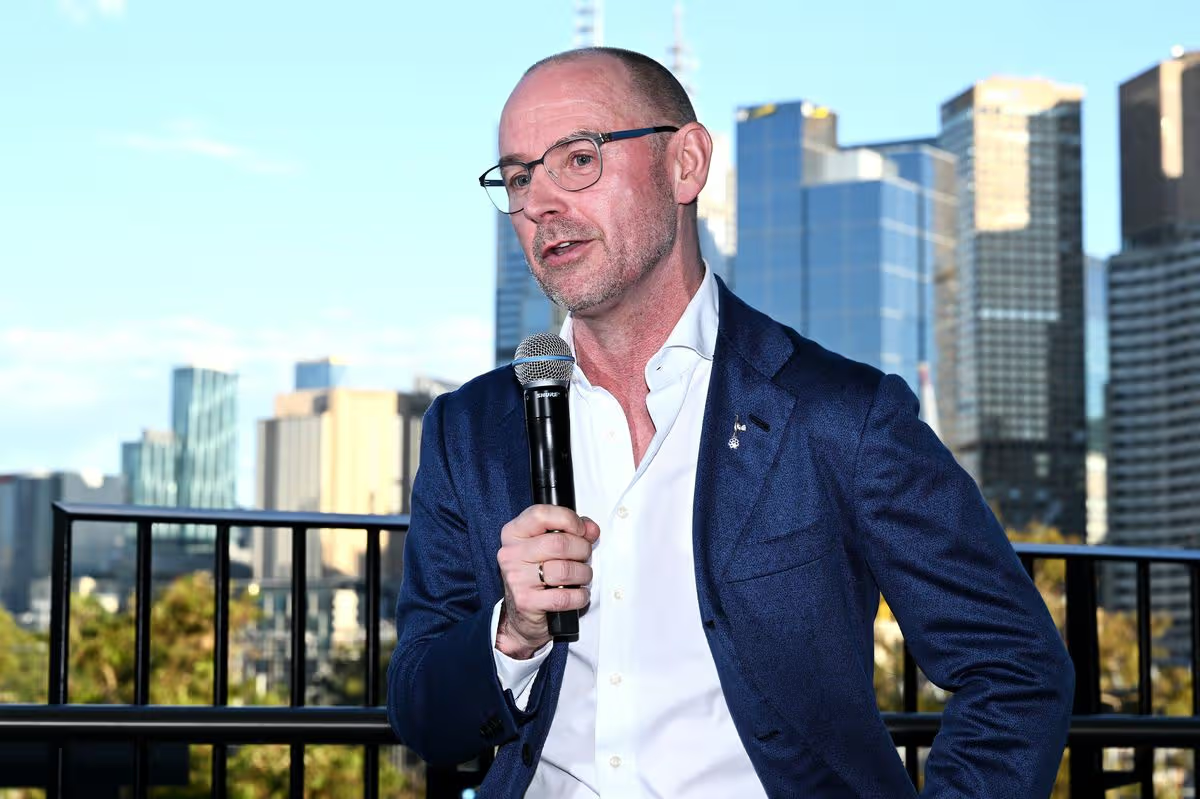
The inner workings of a modern football club often remain shrouded in mystery until an insider decides to speak out. Recently, Scott Munn, the former Chief Football Officer at Tottenham Hotspur, shared a candid look at his two-year tenure in North London during an interview in his native Australia.
Having moved from the highly successful City Football Group to the high-pressure environment of the Premier League, Munn’s perspective offers a unique window into why one of England’s most famous clubs has struggled to find a consistent winning formula. From medical department frustrations to the weight of a complicated club culture, Munn’s reflections explain a great deal about the current state of the team.
One of the most persistent issues at Tottenham has been a recurring injury crisis. This season, new manager Igor Tudor arrived at the training ground to find only thirteen outfield players available for his first session. This was not a new problem.
Munn revealed that during his time at the club, he initiated a deep-dive review into every single department, including the academy and the medical wing. His goal was to modernize the medical infrastructure, bringing it up to a standard that matched the top clubs in the world.
However, the road to change was blocked by internal resistance. Munn explained that while some of his recommendations were accepted, others were flatly rejected.
He described this as a far from optimal outcome, suggesting that the inability to fully overhaul the medical department is a primary reason why the club continues to see its best players sidelined for long periods. For Munn, the “accused” status the club holds regarding its injury record is something he is willing to acknowledge, simply because the totality of the changes needed was never fully realized.
Beyond the physical health of the players, Munn touched on a much deeper issue: the club’s psychological health. Coming from the Manchester City environment, where anything less than first place was considered an objective failure, he noticed a stark difference in mentality at Spurs.
He recalled a board meeting at City where the chairman, Khaldoon Al-Mubarak, opened the session by stating that finishing second in the league was unacceptable. That relentless drive for perfection was instilled in every employee, from the boardroom to the pitch.
At Tottenham, Munn felt a different energy. He pointed to the historical turnover of seventeen managers in twenty years as evidence of a culture that struggles with long-term stability.
He highlighted two specific games that defined his confusion regarding the club’s identity. The first was a loss to Chelsea where the team, down to nine men, continued to attack recklessly with the goalkeeper playing as a sweeper on the halfway line. While it showed spirit, it lacked the cold pragmatism required for top-level success.
The second, and perhaps more troubling moment for him, was a match against Manchester City where a segment of the fan base openly wished for their own team to lose just to prevent their rivals, Arsenal, from winning the league. Munn admitted he could not wrap his head around this sentiment.
While he respected the intensity of the rivalry, the idea of working in professional sports and not wanting to win every single game was completely alien to him. In his view, at the highest level of sport, the margin for error is so tiny that even a slight shift in mentality can be the difference between winning a trophy and finishing mid-table.
Despite these frustrations, Munn spoke very highly of his relationship with former head coach Ange Postecoglou. Together, they navigated a rollercoaster period for the club. In their first year, they managed to lift the team from an eighth-place finish to fifth.
In the second year, they secured the club’s first major trophy in two decades by winning the Europa League, which also guaranteed them a spot in the Champions League.
| Tottenham Performance Metrics (Munn Era) | Season 1 | Season 2 |
| Premier League Finish | 5th | 17th |
| European Success | N/A | Europa League Winners |
| Qualification | Europa League | Champions League |
| Managerial Stability | Postecoglou | Frank / Tudor |
Munn defended the decision to prioritize European success even as their Premier League form collapsed, resulting in a disastrous 17th-place finish. He explained that a choice had to be made about where to put their limited physical and mental energy.
For a club that had been starved of silverware for twenty years, the decision was to go all-in on a trophy. While that choice eventually led to the end of his and Postecoglou’s time at the club, he remains proud of the achievement.
Munn’s admiration for Postecoglou remains strong. He described the manager as a selfless leader who consistently took responsibility for results while ensuring those around him were given the opportunity to grow.
This is evidenced by how quickly Postecoglou’s former staff members moved into major roles elsewhere after leaving London. Munn even mentioned that the two remain close friends and continue to use each other as sounding boards.
Reflecting on the intense pressure of the English game, Munn described the daily scrutiny in the Premier League as “suffating.” Having worked in Australian rules football, he was used to media attention, but he found that London was on an entirely different level.
The sheer number of journalists and the constant exposure made it difficult to protect the squad from outside noise. He felt that some of the media’s skepticism toward Postecoglou often focusing on his background in Japan and Australia was unfair, though he believed the manager eventually won people over with his education and results.
Now that Munn has moved on to a new role in Italy, his reflections serve as a cautionary tale. He clearly loved his time in North London and the friends he made, but his words suggest that until Tottenham can align its medical standards, its boardroom culture, and its winning mentality into a single, cohesive unit, the cycle of frustration may continue. The talent is clearly there, but as Munn learned, talent alone is rarely enough to overcome a fragmented culture.
