The honeymoon period for any new manager usually offers a brief window of optimism, but for Igor Tudor at Tottenham Hotspur, that window was slammed shut before it even truly opened. The Croatian coach has walked straight into the history books for all the wrong reasons, becoming the first manager in the long and storied annals of the club to lose his first four matches in charge.
While the domestic form was already alarming, the midweek trip to the Spanish capital for a Champions League encounter with Atletico Madrid saw the team sink to depths that few supporters thought were possible. Finding themselves four goals down within just twenty-two minutes, the North London side looked like a group that had completely forgotten how to compete at the highest level.
Although the match eventually ended in a 5-2 defeat a scoreline that, by some miracle of modern mathematics, leaves the tie technically alive for the second leg the footballing world has been focused on a single, ruthless decision made by Tudor on the touchline.
Just sixteen minutes into the game, Tudor hauled young goalkeeper Antonin Kinsky off the pitch. This was particularly controversial because Tudor himself had made the bold, high-risk call to start the inexperienced Czech over the club’s established number one, Guglielmo Vicario.
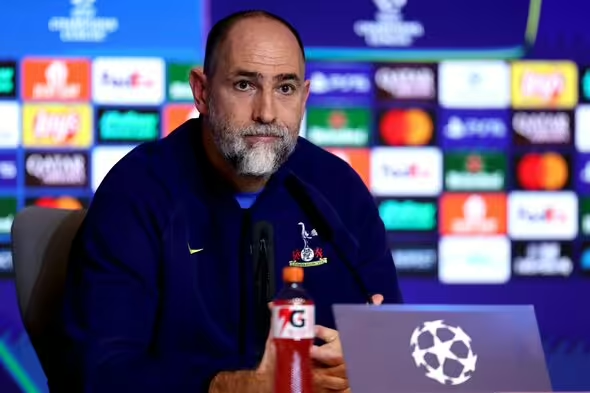
To see a young player publicly humiliated in such a fashion has drawn a wave of condemnation, most notably from former Spurs keeper Joe Hart, who criticized the manager for failing to protect his player.
However, for those who have followed Tudor’s career, this brand of uncompromising and often abrasive leadership is nothing new. He is a man who operates on the principle of total authority, and if history is any indication, the Tottenham dressing room has officially been warned: you are either with him, or you are out.
This “my way or the highway” philosophy was most famously on display during his time at Marseille. In the south of France, Tudor didn’t just ruffle feathers; he tore the wings off. During that tenure, he reportedly banished five separate players from training sessions after various fall-outs and confrontations.
| Player Banned | Club | Reason for Ban/Conflict |
| Gerson | Marseille | Involved in a direct confrontation with Tudor |
| Jordan Amavi | Marseille | Reported bust-up during training |
| Nuno Tavares | Marseille | Removed from sessions for tactical/disciplinary reasons |
| Bamba Dieng | Marseille | Excluded from the first-team dynamic |
| Matteo Guendouzi | Marseille | ‘Lively altercation’ during a pre-season match |
The friction in Marseille started almost immediately with a grueling pre-season that pushed many established stars to their breaking point. The Brazilian midfielder Gerson was one of the first to feel the heat, finding himself excluded from training after a heated exchange with the coach.
He was quickly followed by Jordan Amavi, whose own bust-up with Tudor led to an immediate removal from the squad. Even players like Nuno Tavares and Bamba Dieng found themselves on the outside looking in, often without a clear public explanation, as Tudor sought to consolidate his power and remove any perceived dissent.
Perhaps the most famous clash involved former Arsenal midfielder Matteo Guendouzi. Known for his own fiery temperament, Guendouzi reportedly engaged in a “lively altercation” with Tudor during a pre-season friendly.
Legend has it that the Frenchman was so incensed that he went for a shower at halftime and simply never came back out to the bench. It was a clear sign that the relationship between the squad and the manager had become toxic.
Marseille president Pablo Longoria later admitted that the environment was incredibly hostile, noting that Tudor found himself in a situation where almost everyone, both inside and outside the club, seemed to be working against him. Some fans were even calling for the return of the previous manager while others argued that the players should have more power.
This history is particularly relevant now as Tottenham stares down the barrel of a potential relegation battle. Tudor has already demonstrated at Spurs that he is willing to make “bold calls” regardless of the emotional fallout.
The Kinsky substitution was a signal to the entire squad that no one is safe and that reputations mean very little. In a dressing room that has been accused of being too comfortable or lacking “personality,” Tudor is clearly trying to shock the system.
But as his Marseille experience shows, this approach is a double-edged sword. While it can instill discipline, it can also lead to a complete breakdown in team unity at a time when the club needs it most.
As the second leg against Atletico Madrid approaches, the focus will not just be on the tactics, but on the casualties. If Tudor continues to “banish” those who don’t fit his rigid mold, the Tottenham squad could look very different by the end of the month.
The manager remains “100 per cent” sure that Spurs will stay in the Premier League, but his method of getting there involves a level of internal warfare that the club hasn’t seen in years. Whether the players respond to this warning or organize their own resistance much like the players did in Marseille will determine whether Tudor survives the season or becomes another footnote in a chaotic year for the Lilywhites.
