The professional landscape of elite football is often a whirlwind of rapid arrivals and even faster departures, a reality recently underscored by the brief and somewhat chaotic tenure of John Heitinga at Tottenham Hotspur.
When Thomas Frank initially brought the former Dutch international into his coaching fold on January 15th, the goal was to inject fresh tactical ideas into a side that had managed only seven wins from twenty-six league outings.
However, the stability Heitinga sought was never realized. Following Frank’s dismissal on February 11th and the subsequent appointment of Igor Tudor, the Dutchman’s time in North London came to a sudden halt. While initial rumors suggested he was pushed out, his representative, Rob Jansen, has now stepped forward to provide a candid look at the high-stakes decision-making happening behind the scenes.
Speaking on the popular podcast KieftJansenEgmondGijp, Jansen revealed a perspective that contradicts the usual narrative of a “clearing of the house.” Contrary to popular belief, the Tottenham hierarchy did not want Heitinga to leave. In fact, they reportedly pleaded with him to stay.
This is a significant revelation, especially considering that almost the entirety of Frank’s Scandinavian coaching staff was shown the door immediately. According to Jansen, the club was so impressed with Heitinga’s impact over just a three-week period that they asked him to honor his contract and serve as a bridge to the new regime. It is rare for a coach to earn such high regard in such a short window, yet Heitinga made the choice to walk away.
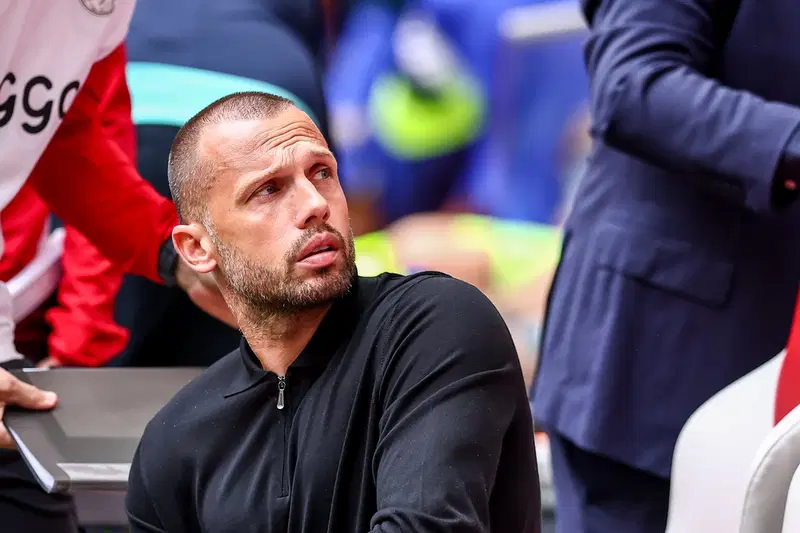
The reason for this departure, as Jansen explains it, was rooted in a mixture of professional pragmatism and a lack of faith in the club’s long-term planning. When Igor Tudor was brought in as an interim “fireman” to extinguish the flames of a poor season, he arrived with a full complement of his own Croatian staff. Heitinga saw the writing on the wall.
To him, staying for three or four months under a temporary manager who specializes in “emergency jobs” felt like a move toward nowhere. He recognized that even if he stayed through the end of the season, the permanent manager hired in the summer would inevitably arrive with a massive entourage of their own—jokingly referred to by Jansen as “45 people.”
Heitinga realized he would simply be delaying the inevitable and decided it was better to preserve his professional standing by leaving now rather than being fired twice in one year.
Jansen also pulled back the curtain on the original plan when Heitinga first signed his contract. There was a quiet understanding, at least on the part of the agent and the coach, that Heitinga was being positioned as the heir apparent to Thomas Frank.
They had anticipated a scenario where he might take over the top job if the results didn’t improve under the Dane. However, when the moment of truth arrived, the Spurs leadership and specifically the Lewis family blinked. They lacked the confidence to hand the reins to a relatively untested coach in the middle of a crisis.
Instead of taking a bold risk on Heitinga, they retreated into what they perceived as “security,” hiring a known crisis manager to stabilize the club’s image and perhaps save their own reputations in the eyes of a frustrated fan base.
| Event | Date | Outcome |
| Heitinga Joins Spurs | Jan 15, 2026 | Added to Thomas Frank’s staff to fix a poor run. |
| Thomas Frank Sacked | Feb 11, 2026 | Club sits 16th; management looks for “crisis” help. |
| Igor Tudor Appointed | Feb 14, 2026 | Interim role until summer; brings own staff. |
| Heitinga Resigns | Feb 20, 2026 | Refuses to stay as a “placeholder” coach. |
The agent’s critique of the club’s owners was particularly sharp. He suggested that the move for Tudor was a “mystery” and a decision born out of a “state of panic.” By opting for a short-term fix, Jansen argues, the club effectively admitted they were more concerned with optics than with building a sustainable coaching foundation.
The Lewis family, according to this account, prioritized a manager with a track record of survival over a coach who could have potentially provided a long-term vision. It was a choice for “known security” over “unknown potential,” a move that Heitinga viewed as a dead end.
Despite the frustration surrounding the exit, Heitinga did not leave empty-handed. When asked about financial compensation, Jansen was characteristically blunt, noting that he is highly skilled at “drawing up contracts in advance.”
While the specific figures remain private, it is clear that Heitinga was well-protected against the volatility of the Premier League. The Dutchman leaves London with his reputation intact, having been wanted by a top club even during their darkest hour.
For Tottenham, however, the departure of a coach they desperately wanted to keep adds another layer of complexity to a season already defined by uncertainty. They are left with a temporary manager and a staff that knows their days are numbered, while the man who could have been their future has already moved on to the next chapter.
