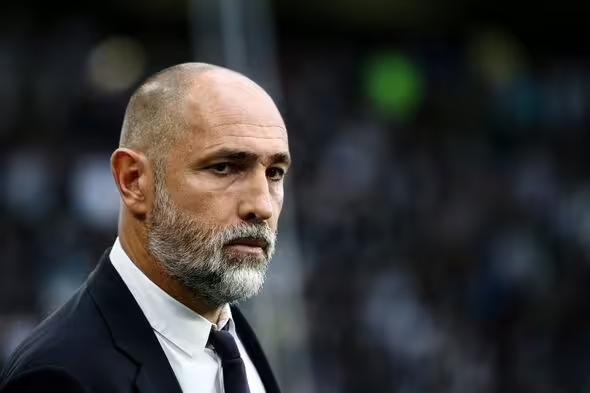
In the high-pressure world of the Premier League, first impressions are everything, and Igor Tudor seems to be winning over the Tottenham faithful before even a single ball has been kicked under his leadership.
Stepping into the void left by the departure of Thomas Frank, the Croatian manager has inherited a squad that was drifting dangerously toward a crisis. While the primary focus usually lands on the tactical changes a new manager makes on the pitch, Tudor’s early victory has actually taken place behind the scenes in the corridors of the training ground.
By carefully selecting which staff to bring in and, perhaps more importantly, which ones to keep, he has signaled a level of pragmatism that has impressed club insiders and fans alike.
Tudor has moved quickly to finalize his backroom team, blending fresh perspectives with vital continuity. He has brought in trusted lieutenants such as Bruno Saltor, Tomislav Rogic, and Riccardo Ragnacci. Saltor, in particular, is a savvy addition; with over 250 appearances for Brighton, he possesses an intimate knowledge of the English game that Tudor, coming from Italy and Croatia, might initially lack.
Most of the new staff previously worked alongside Tudor during his tenure at Juventus, ensuring a shared footballing language from day one. However, it is the decision to retain certain members of the previous regime that has drawn the most praise from club observers like John Wenham.
Wenham believes the most inspired move Tudor has made so far is keeping Andreas Georgson on board as the club’s set-piece expert. In a season where Tottenham’s overall form has been inconsistent at best, their efficiency in “dead-ball” situations has been a rare and shining light.
Georgson has transformed Spurs into one of the most dangerous teams in the league when the ball is stationary, and many believe that without his specific contributions, the club’s league position would be even more precarious. Tudor’s willingness to recognize Georgson’s value, rather than simply clearing out the entire staff to bring in his own people, suggests a manager who prioritizes results over ego.
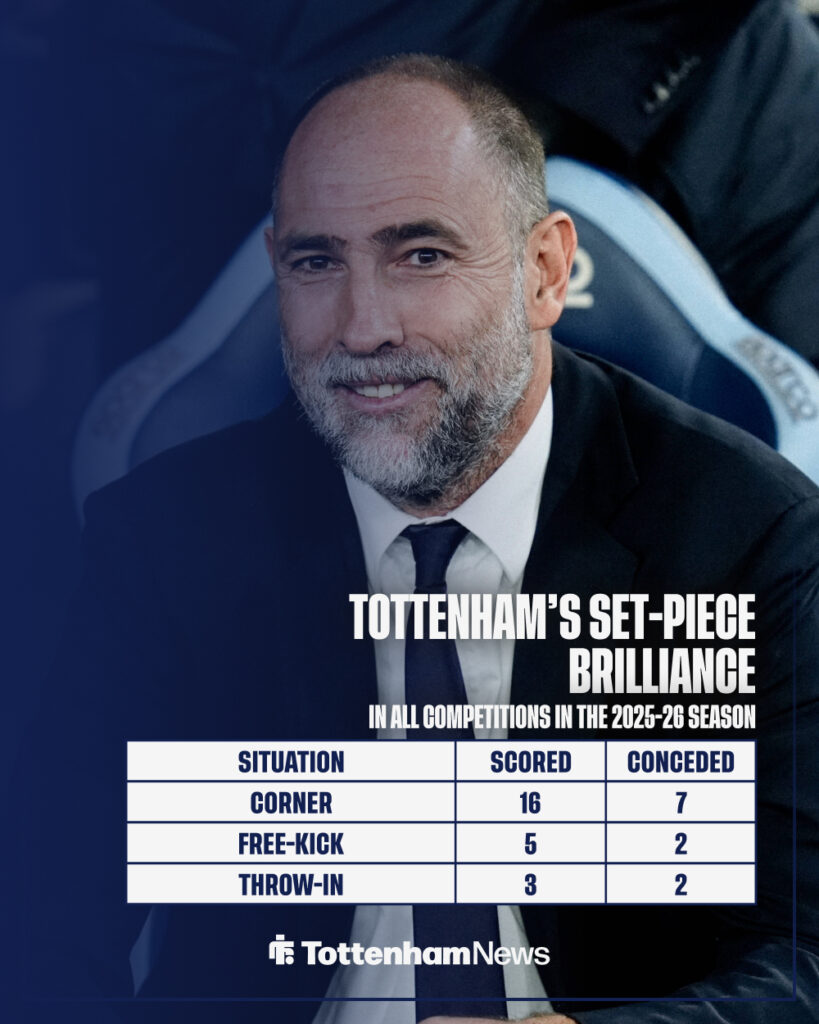
The numbers backing up Georgson’s impact are nothing short of remarkable. According to recent data, the Lilywhites have managed to turn set-pieces into a genuine weapon of war. Throughout the current campaign, they have found the net 27 times from these situations while only conceding on seven occasions.
This is a massive swing in goal difference that can be the deciding factor between a relegation scrap and a push for Europe. When you break those figures down further, the influence of the Swedish coach becomes even more apparent.
The North London side has been particularly lethal from corner kicks, recording 16 goals while only allowing seven at the other end. Their proficiency extends to free-kicks as well, where they have scored five times and conceded only twice.
Even the often-overlooked area of throw-ins has been productive, yielding three goals for the side. Although they did suffer a lapse during a recent 2-2 draw with Burnley where they conceded twice from throw-in scenarios, the overall record remains one of the best in the top flight.
By keeping Georgson in his post, Tudor is essentially ensuring that he doesn’t have to rebuild every department of the team from scratch. He can focus his energy on fixing the open-play issues and the defensive organization while knowing that the set-piece “engine” is already running at peak performance.
Alongside Georgson, Tudor has also opted to keep goalkeeping coach Dean Brill and academy influence Stuart Lewis, creating a bridge between the new coaching philosophy and the existing club culture.
This blend of old and new has created a sense of stability that was sorely lacking during the final months of Thomas Frank’s time in North London. Fans are generally supportive of a “reset,” but they are also wary of losing the few things that were actually working.
Tudor’s decision-making shows a high level of emotional intelligence and a deep understanding of what it takes to “steady a ship.” If Tottenham can maintain their elite record in set-piece situations while Tudor improves their tactical flexibility in open play, the dark clouds that have hung over the stadium might finally begin to clear. For now, the fans are happy, the experts are impressed, and the new era is off to a very sensible start.
